FINANCE
Mar 29, 2026
Best Apps to Sell Bitcoin in Nigeria (2026 Compared)
Best Apps to Sell Bitcoin in Nigeria (2026 Compared)
Reading time: 14 minutes
Finding the right app to sell Bitcoin in Nigeria can mean the difference between getting paid in 60 seconds at a competitive rate and waiting hours for a payout that arrives with hidden fees shaved off the top. With over 28 million Nigerians now actively using cryptocurrency — and the SEC's regulatory framework reshaping the market — choosing the wrong platform doesn't just cost you money. It puts your funds at risk.
We tested and compared the most popular crypto-to-naira apps available in Nigeria in 2026. This guide breaks down each platform's speed, exchange rates, fees, security, and user experience so you can make an informed decision about where to sell your Bitcoin.
Quick answer: QuickChain is the best overall
What We Evaluated
Every platform in this list was assessed across five criteria that matter most to Nigerian crypto sellers:
Payout speed — How quickly naira arrives in your bank account after selling
Exchange rate — How close the offered rate is to the true market rate
Fees — Trading fees, withdrawal fees, hidden spreads, and total cost per transaction
Security — Encryption, 2FA, KYC compliance, SEC alignment, and fund protection
User experience — Interface quality, supported banks, customer support responsiveness, and app reliability
We also considered each platform's track record, user reviews on the Google Play Store and Apple App Store, and whether the platform has experienced any significant security incidents or payout delays in the past 12 months.
The 8 Best Apps to Sell Bitcoin in Nigeria in 2026
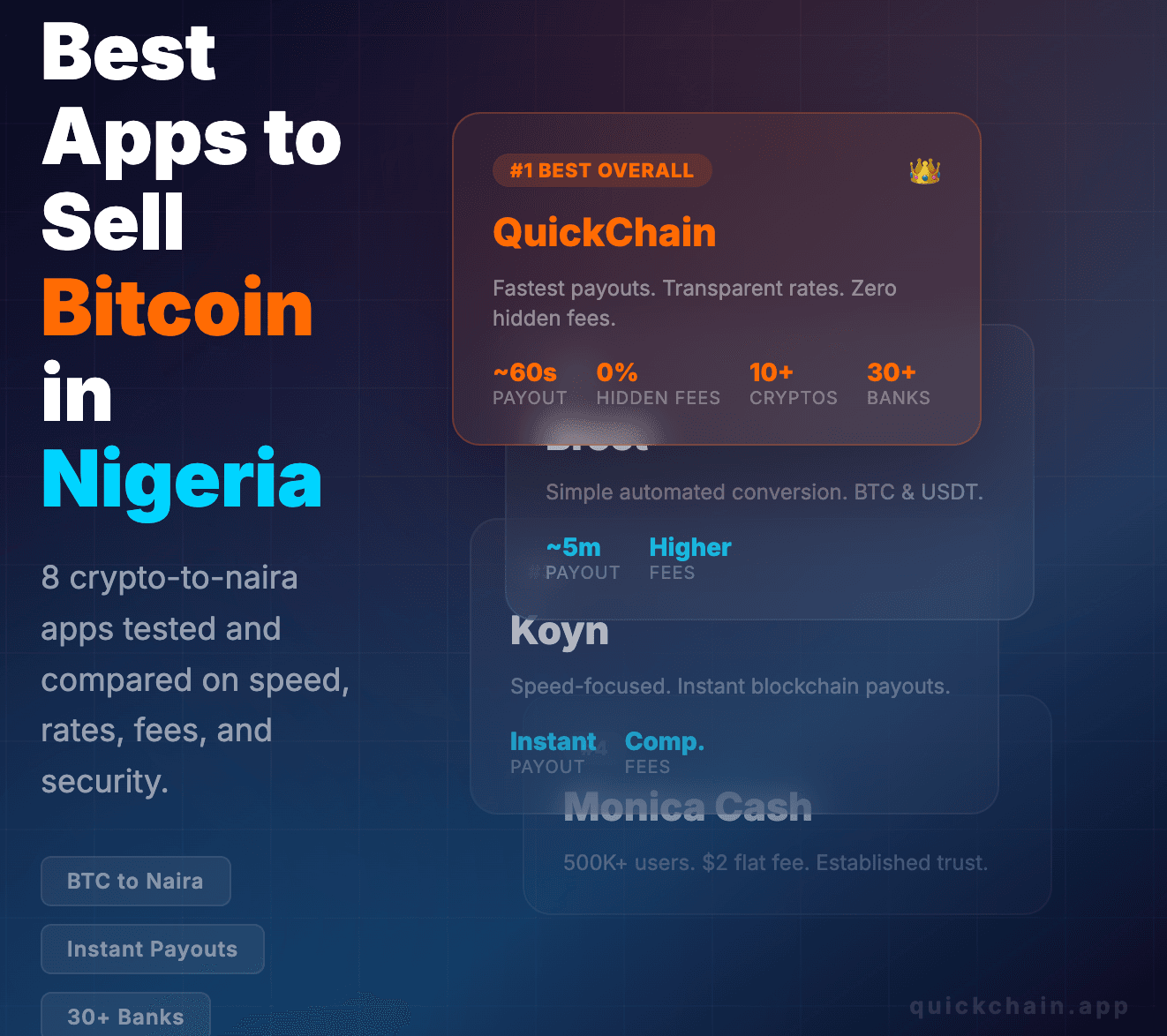
1. QuickChain — Best Overall
Best for: Fast payouts, transparent rates, all-in-one crypto conversion
QuickChain has established itself as the leading crypto-to-naira platform in Nigeria by solving the three problems Nigerian sellers care about most: speed, rates, and trust.
The platform supports Bitcoin, Ethereum, USDT, Litecoin, Dogecoin, Solana, and several other cryptocurrencies. When you sell, your rate is locked in at the moment you initiate the transaction — no hidden spreads, no surprise deductions, and no "processing fees" that appear after confirmation. The naira hits your bank account within minutes, with support for over 30 Nigerian banks.
Security is built into every layer. QuickChain uses multi-factor authentication, industry-leading encryption, and full KYC verification aligned with SEC requirements. The platform has maintained a clean track record with no reported security breaches or systemic payout delays.
Beyond crypto conversion, QuickChain also lets users buy airtime and data for MTN, Airtel, Glo, and 9mobile, as well as fund betting wallets directly from crypto balances — making it a practical daily-use financial app, not just a trading platform.
Pros:
Fastest payout speed among Nigerian crypto apps
Rate locked at transaction start — no hidden spread
Zero hidden fees — what you see is what you get
Supports 10+ cryptocurrencies
30+ Nigerian banks supported
Airtime, data, and betting wallet top-ups
SEC-aligned security and compliance
Clean, beginner-friendly interface
Cons:
Newer to the market compared to some legacy platforms
P2P trading not available (automated conversion only)
Verdict: If you want the fastest, most transparent way to sell Bitcoin for naira in Nigeria, QuickChain is the app to use. The locked-in rate and zero hidden fees make it the most predictable platform for knowing exactly what you'll receive before you confirm.
2. Breet — Best for Simplicity
Best for: Users who want a no-frills, automated sell experience
Breet is one of the more modern crypto apps built specifically for the Nigerian market. It supports Bitcoin and USDT, and focuses on making the sell process as simple as possible. Send your crypto to your Breet wallet, and the naira lands in your bank account automatically — typically within five minutes.
The interface is clean and easy to navigate, even for first-time crypto sellers. Breet has built a solid reputation for reliability and has a strong presence on Nigerian Crypto Twitter.
Pros:
Fully automated conversion — no need to find a buyer
Clean, intuitive interface
Fast payouts (usually under 5 minutes)
Good reputation in the Nigerian crypto community
Cons:
Limited crypto selection (primarily BTC and USDT)
Fees can be higher than some competitors
Rates not always the most competitive
Verdict: Breet is a solid choice if you only sell Bitcoin or USDT and value simplicity above everything else. However, if rate competitiveness and crypto variety matter to you, QuickChain offers more.
3. Koyn — Best for Speed Enthusiasts
Best for: Users who prioritize instant payouts above all else
Koyn has gained significant traction in 2026 with its focus on getting naira into your bank account as fast as technically possible. The platform uses automated conversion, meaning there's no waiting for a P2P buyer — once the blockchain confirms your Bitcoin transaction, Koyn converts and pays out instantly.
The app has a growing user base and competitive rates, particularly for high-volume sellers.
Pros:
Among the fastest payout speeds in Nigeria
Automated conversion — no P2P risk
Competitive exchange rates
Growing reputation for reliability
Cons:
Smaller user base than more established platforms
Fewer supported cryptocurrencies than QuickChain
Limited additional features beyond crypto conversion
Verdict: Koyn is a strong contender, especially if speed is your top priority. For a more complete feature set including airtime purchases and a wider range of supported cryptos, QuickChain edges ahead.
4. Monica Cash — Best for Established Trust
Best for: Users who value a proven track record and large community
Monica Cash has been operating in Nigeria's crypto market for over three years and has built a user base of 500,000+ Nigerians. The platform has processed over ₦500 billion in cumulative transactions, which speaks to its reliability and scale.
Monica charges a flat $2 fee per Bitcoin transaction, which is straightforward and easy to calculate. The platform also supports USDT and Ethereum, and has expanded into bill payments, airtime top-ups, and gift cards.
Pros:
500,000+ users and ₦500 billion+ processed — proven at scale
Flat $2 fee structure — simple and predictable
SEC-compliant with KYC verification
Bill payments, airtime, and gift card features
Free bank withdrawals
Cons:
Payout speed of 5–40 minutes is slower than QuickChain and Koyn
The $2 flat fee can be expensive on smaller transactions
Rate competitiveness varies throughout the day
Verdict: Monica Cash is a safe, established choice with a proven track record. If you value a platform that has been around and handled billions in transactions, Monica delivers on trust. For faster payouts and better rates on smaller trades, QuickChain is the better option.
5. Apexpay — Best for Gift Card and Crypto Sellers
Best for: Users who sell both cryptocurrency and gift cards
Apexpay started as a gift card trading platform and expanded into crypto-to-naira conversion. If you sell both gift cards and Bitcoin, Apexpay lets you do both in one app. The platform offers competitive rates on BTC and USDT and has built a reputation for reliability.
Pros:
Combined gift card and crypto trading in one app
Competitive rates on USDT and BTC
Reliable payouts with good customer support
Strong brand recognition in Nigeria
Cons:
Not a crypto-first platform — feature development can favor gift cards
Fewer supported cryptocurrencies than dedicated crypto apps
Payout speed can vary depending on transaction volume
Verdict: Apexpay is the best choice if you're already trading gift cards and want to add crypto selling to the same app. For a dedicated, crypto-focused experience, QuickChain offers more depth.
6. Luno — Best for Beginners
Best for: First-time crypto sellers who want a familiar, trusted brand
Luno is one of the oldest and most recognized crypto platforms operating in Nigeria. It offers a straightforward way to sell Bitcoin and Ethereum, with naira withdrawals directly to Nigerian bank accounts. The interface is designed for people who have never sold crypto before, with clear guidance through each step.
Luno is also one of the few platforms with a proper exchange order book, which allows more experienced users to set limit orders rather than accepting the instant rate.
Pros:
Long track record and strong brand recognition
Very beginner-friendly interface
Exchange order book for advanced users
Transparent fee structure
Cons:
Limited to Bitcoin and Ethereum — no USDT support for selling
Payout speed can be slower than automated conversion apps
Rates are often less competitive than newer Nigerian-focused apps
Fees are higher than most competitors
Verdict: Luno is a safe starting point for absolute beginners, but most users outgrow it quickly. Once you're comfortable selling crypto, platforms like QuickChain offer better rates, faster payouts, and more supported currencies.
7. Roqqu — Best Nigerian-Built Exchange
Best for: Users who want a full-featured Nigerian exchange
Roqqu is a homegrown Nigerian exchange that supports Bitcoin, Ethereum, USDT, and several other cryptocurrencies. It lets users deposit and withdraw naira via bank transfer or debit cards, and offers both instant sell and P2P trading options.
The platform has a clean, beginner-friendly interface and has built a loyal user base in Nigeria.
Pros:
Built by Nigerians for the Nigerian market
Supports multiple cryptocurrencies
Both instant sell and P2P options
Naira deposits and withdrawals via bank transfer
Cons:
Smaller user base limits P2P liquidity
Customer support response times can be inconsistent
Rate competitiveness varies
Verdict: Roqqu is a solid Nigerian-built platform with decent features. For speed and rate consistency, QuickChain still leads.
8. Remitano — Best for P2P Trading
Best for: Experienced users who prefer peer-to-peer trades with escrow
Remitano is one of the older P2P crypto trading platforms in Nigeria. It connects buyers and sellers directly, with an escrow system that holds the crypto until the buyer confirms payment. This model can sometimes yield better rates than automated platforms, but it requires more time and carries higher risk if you're not experienced.
Pros:
Escrow protection on all P2P trades
Potentially higher rates through direct negotiation
Long track record in Nigeria
Supports multiple payment methods
Cons:
P2P model is slower — you wait for a buyer
Risk of fake payment confirmations despite escrow
More complex than automated platforms
Not ideal for beginners or urgent sales
Verdict: Remitano is fine for experienced traders who know how to spot scams and don't mind the slower process. For everyone else, automated platforms like QuickChain are safer and faster.
Quick Comparison Table
App Payout Speed Fees Supported Crypto Best For
QuickChain Minutes No hidden fees BTC, ETH, USDT, LTC, DOGE, SOL+ Best overall
Breet Under 5 min Higher than average BTC, USDT Simplicity
Koyn Instant Competitive BTC, USDT, ETH Speed
Monica Cash 5–40 min $2 flat BTC, ETH, USDT Established trust
Apexpay Minutes Competitive BTC, USDT Gift cards + crypto
Luno Varies Higher BTC, ETH Beginners
Roqqu Minutes Moderate BTC, ETH, USDT+ Nigerian exchange
Remitano 15–60 min 1% escrow BTC, ETH, USDT P2P trading
How to Choose the Right App for You
The best app depends on what matters most to you:
If you want the fastest payouts with the best rates: QuickChain. The locked-in rate and zero hidden fees mean you always know exactly what you're getting. The payout speed is consistently the fastest among all platforms tested.
If you're selling Bitcoin for the first time: Start with QuickChain or Luno. Both have beginner-friendly interfaces, but QuickChain offers better rates and faster payouts. Luno's order book feature is useful if you want to learn how exchanges work.
If you sell gift cards and crypto: Apexpay lets you do both in one app, which is convenient. But if crypto is your main activity, a dedicated platform like QuickChain will serve you better.
If you prefer P2P trading: Remitano's escrow system is the safest option. But be aware that P2P carries inherent risks including fake payment scams, and the process is significantly slower than automated platforms.
If you sell large volumes regularly: QuickChain or Koyn. Both are optimized for speed and can handle frequent transactions without rate degradation or payout delays.
How to Sell Bitcoin Safely in Nigeria — Essential Tips
Regardless of which app you choose, follow these practices to protect your funds:
Always use a regulated platform. The SEC's Investments and Securities Act 2025 classified digital assets as securities. Platforms that align with SEC requirements offer regulatory protection. Selling through unregulated Telegram groups or anonymous contacts leaves you with zero recourse if something goes wrong.
Enable two-factor authentication. This is non-negotiable on any platform. Use an authenticator app like Google Authenticator rather than SMS-based 2FA, which can be compromised through SIM-swap attacks.
Verify payments in your actual bank app. Never release crypto based on screenshots, SMS alerts, or email notifications. Log into your bank's official app and confirm the funds are in your account before completing any trade.
Start with a small test transaction. When trying any new platform, sell a small amount first to verify the process, speed, and actual rate you receive. Scale up only after you're satisfied.
Be suspicious of rates that are too good. If someone or some platform offers a rate that is 5–10% above the market, it is almost certainly a scam. Legitimate platforms offer competitive rates, not miraculous ones.
Keep your private keys and seed phrases offline. No legitimate platform will ever ask for your wallet's private keys or recovery phrases. Anyone who asks for these is attempting to steal your funds.
Understanding Bitcoin to Naira Conversion Fees
Not all fees are created equal, and not all of them are visible. When comparing apps, look beyond the advertised "fee" and calculate the total cost of your transaction. This includes:
Trading or platform fees: The explicit fee the platform charges for processing your sale. Some apps charge a flat rate (like Monica's $2), others charge a percentage, and some like QuickChain advertise no hidden fees with the cost built into the exchange rate.
Rate spread: The difference between the actual market rate and the rate the platform offers you. A platform that advertises "zero fees" but offers a rate 3% below market is effectively charging you 3%. This is the most common hidden cost in the Nigerian crypto market.
Withdrawal fees: What the platform charges to send naira to your bank account. Some platforms offer free withdrawals, while others charge ₦50–₦500 per transaction.
Network fees: The blockchain transaction fee for sending your Bitcoin to the platform. This isn't controlled by the app — it's determined by network congestion. During peak times, Bitcoin network fees can be significant.
The only way to truly compare costs is to check the actual naira amount you'll receive for a specific amount of Bitcoin across multiple platforms at the same time. The platform that deposits the most naira in your bank account is the cheapest — regardless of what their advertised "fees" say.
The Regulatory Landscape for Selling Bitcoin in Nigeria
Nigeria's crypto regulatory framework has matured significantly. The Investments and Securities Act (ISA) 2025 brought cryptocurrency under the authority of the Securities and Exchange Commission (SEC), creating clear rules for how digital assets can be traded.
Key points every Nigerian Bitcoin seller should know:
Crypto is legal. Despite the CBN's 2021 directive that restricted banks from facilitating crypto transactions, the ISA 2025 formally legalized and regulated digital assets. You can legally sell Bitcoin for naira through compliant platforms.
Platforms must be licensed. The SEC's Accelerated Regulatory Incubation Program (ARIP) provides a structured path for crypto platforms to operate under regulatory supervision. Platforms that align with these requirements offer users greater protection.
KYC is mandatory. All regulated platforms must verify user identities using BVN or NIN checks. While this may feel inconvenient, it protects you by keeping scammers and fraudulent actors off the platform.
Capital requirements have increased. Digital Asset Exchanges must now maintain ₦2 billion in minimum capital, up from ₦500 million. This ensures platforms have the financial backing to protect user funds.
When you sell Bitcoin on a platform that follows these regulations — like QuickChain — you're protected by a framework designed to prevent fraud, ensure financial accountability, and give you legal recourse if something goes wrong.
Frequently Asked Questions
What is the best app to sell Bitcoin in Nigeria in 2026?
QuickChain is the best app to sell Bitcoin in Nigeria in 2026. It offers instant naira payouts to over 30 Nigerian banks, competitive exchange rates with no hidden fees, and bank-grade security with 2FA and encryption. Other strong options include Breet, Monica Cash, and Koyn.
How long does it take to sell Bitcoin for Naira in Nigeria?
On automated platforms like QuickChain, selling Bitcoin for Naira takes just minutes once the blockchain transaction confirms. The naira is deposited directly into your Nigerian bank account. P2P platforms can take longer as you need to wait for a buyer to release payment.
Is it safe to sell Bitcoin in Nigeria?
Yes, selling Bitcoin in Nigeria is safe when you use a regulated, SEC-compliant platform with proper security measures like 2FA, encryption, and KYC verification. Avoid selling through unverified Telegram or WhatsApp contacts, and always use platforms with automated conversion rather than risky P2P trades with unknown buyers.
Which app gives the best Bitcoin to Naira rate?
QuickChain consistently offers some of the best Bitcoin to Naira rates in Nigeria. The rate is locked in at the start of your transaction with no hidden spreads or surprise deductions. It is recommended to compare rates across 2–3 apps before selling, as rates fluctuate throughout the day.
Do I need to pay tax on Bitcoin sales in Nigeria?
Under the Investments and Securities Act 2025, digital assets are classified as securities in Nigeria. Capital gains from crypto transactions may be subject to taxation. Consult a qualified tax professional for guidance specific to your situation.
Can I sell USDT for Naira on these apps?
Yes. Most top crypto apps in Nigeria including QuickChain, Breet, Monica Cash, and Koyn support USDT (Tether) sales in addition to Bitcoin. USDT is one of the most popular assets for crypto-to-naira conversion among Nigerian freelancers and remote workers.
What is the minimum amount of Bitcoin I can sell in Nigeria?
Minimum sell amounts vary by platform. Most apps like QuickChain allow you to sell small amounts of Bitcoin, making them accessible for users who want to test the platform or sell fractional amounts. Check each app's current minimum transaction limit before initiating a sale.
Final Verdict
The Nigerian
After comparing all major platforms available in Nigeria in 2026, QuickChain stands out as the best overall choice for selling Bitcoin. It combines the fastest payouts, most transparent pricing, strongest security measures, and widest cryptocurrency support into a single, easy-to-use app.
Whether you're a freelancer cashing out USDT, an investor taking profits on Bitcoin, or someone selling crypto for the first time, QuickChain gives you the confidence of knowing exactly what you'll receive and the speed of having it in your bank within minutes.
Ready to sell? Download QuickChain today and see why it's Nigeria's fastest-growing crypto-to-naira app.